Cooling Tower Sizing & Selection Guide (Engineer’s Checklist)
The numbers you need, the formulas behind range and approach, and a step-by-step workflow for specifying an industrial cooling tower.
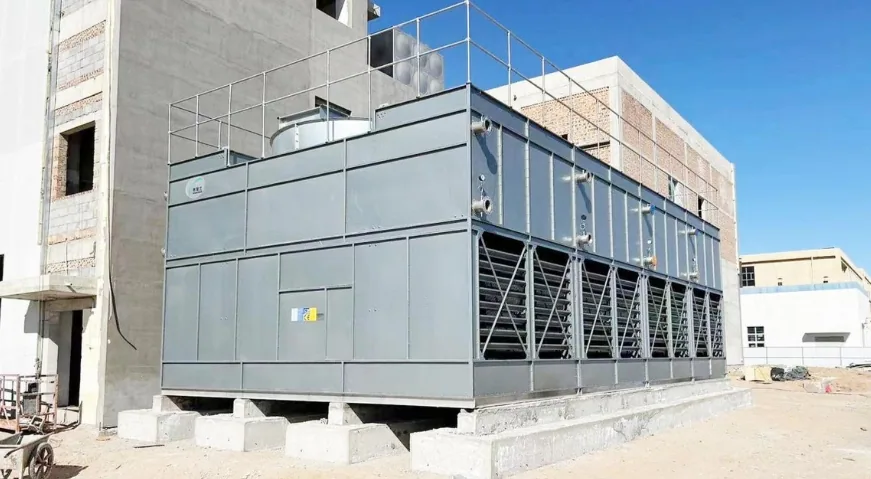
Step 1 — Collect the duty data
Record the heat load Q (kW) or the circulating water flow (m³/h), the hot-water inlet temperature, the required cold-water outlet temperature, and the design wet-bulb temperature at the site (commonly the 1% or 5% exceedance value, not the absolute extreme). Also note water quality, altitude, available footprint, height limit, noise limit and power supply.
If you only know the chiller or process capacity, an engineer can convert it to a heat load — but the wet-bulb assumption must be confirmed with the site, since it drives tower size.
Step 2 — Understand range and approach
Range = inlet temperature − outlet temperature. For a given heat load it follows from Q = m × cp × range, so it is set by the process, not by the tower. Approach = outlet temperature − wet-bulb temperature; it is set by the tower size and design, and it is where the cost sits.
A practical industrial approach is typically in the 3–8 °C band. Halving the approach can require a substantially larger tower, so ask whether the process truly benefits from the colder water before specifying it.
Step 3 — Choose the configuration
Open circuit for best thermal performance and lowest first cost where water treatment is acceptable. Closed circuit fluid cooler where the process loop must stay clean and sealed. Crossflow for low pump head and easy maintenance; counterflow for a compact footprint and higher efficiency; round FRP packaged towers for smaller HVAC and light-industrial duties; fanless hydraulic drive where surplus pump head is available.
Then select the fill from the water analysis (film for clean water, splash or anti-fouling for dirty water), the material (FRP, galvanised or stainless steel), the fan / noise package, VFD or PLC controls, and drift eliminator performance.
Step 4 — Verify before ordering
Request the thermal selection sheet, general arrangement drawing, noise data, electrical schedule, bill of materials, recommended spare-parts list and installation / winter operating procedures. Check that the proposed tower meets the design wet-bulb case and that maintenance access is realistic on your site.
Our engineers will review your duty data and provide a configuration and quotation — free of charge, typically within one business day.
Need this applied to your project?
Send your heat load, flow rate and design wet-bulb temperature for a technical proposal.
Request a QuoteTalk to a cooling tower engineer
Technical selection, drawings and a quotation — usually within one business day.