Types of Cooling Towers: A Practical Classification
Classify cooling towers by airflow direction, draft mechanism and circuit design — and map each type to the applications where it fits best.
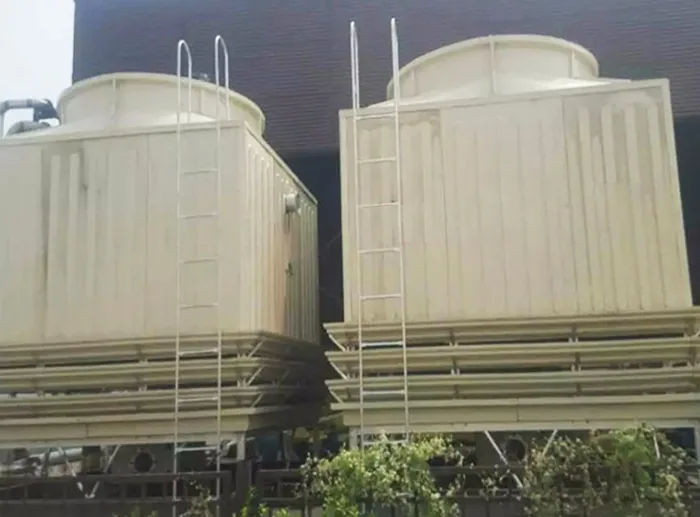
Three independent classifications
A tower is described by airflow direction (crossflow or counterflow), draft mechanism (induced, forced, natural or fanless hydraulic drive), and circuit design (open or closed). For example, a common industrial unit is an induced-draft counterflow open-circuit cooling tower.
Round FRP packaged towers, square crossflow towers, square counterflow towers, closed circuit fluid coolers and fanless towers are the product families we manufacture.
Open vs closed circuit
Open circuit towers spray process water directly over the fill: best thermal performance, lowest first cost, but the water needs treatment. Closed circuit towers keep the process fluid inside a coil while a separate spray loop cools it: cleaner loop, less scaling, water saving in cold weather, at a higher initial cost.
Crossflow offers lower pump head and easier maintenance; counterflow offers a smaller footprint and higher thermal efficiency per unit area.
Mapping to applications
HVAC and commercial buildings favour low-noise crossflow or packaged FRP towers. Heavy process industries favour braced-steel counterflow banks. Furnaces, glycol loops and sensitive processes favour closed circuit coolers. Where surplus pump head exists, a fanless tower eliminates the fan motor entirely.
Need this applied to your project?
Send your heat load, flow rate and design wet-bulb temperature for a technical proposal.
Request a QuoteTalk to a cooling tower engineer
Technical selection, drawings and a quotation — usually within one business day.