Cooling Tower Fill Media Explained
Film fill vs splash fill, PVC vs CPVC/PP, and how fouling quietly destroys thermal performance.
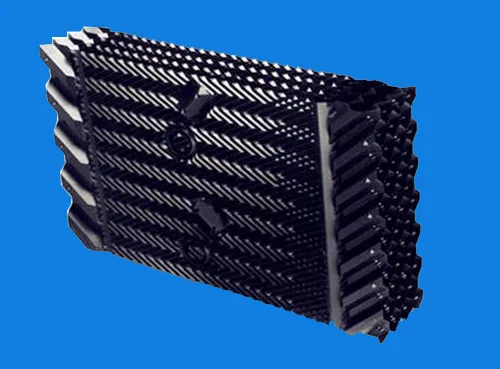
The fill is the heart of the tower
A cooling tower rejects most of its heat through evaporation at the water–air interface. Fill media multiplies that interface area and extends contact time, so fill geometry largely determines how much duty fits into a given volume.
The square crossflow towers we build use dimpled point-wave PVC sheets bonded into rigid blocks; the dimples improve film formation and prevent direct droplet fall-through, while a collection detail at the fill tail limits drift.
Film, splash and anti-fouling
Film fill gives the highest thermal efficiency per cubic metre, but needs reasonably clean water — suspended solids, oil or biological growth block the narrow flutes quickly. Splash fill breaks the water into droplets repeatedly and tolerates poor water quality, at the cost of a larger tower. Low-clog / anti-fouling film fill sits between the two.
PVC is standard for normal temperatures; CPVC or PP is selected for hotter water. If water quality is uncertain, choose a more tolerant geometry rather than the highest-efficiency one.
Service life and replacement
Fouled or collapsed fill is the single most common cause of gradual cooling tower performance loss. Inspect annually, clean where possible, and replace blocks in sets to restore even wetting. We supply fill blocks, drift eliminators, nozzles, fans, motors and reducers as a complete spare-parts package.
Need this applied to your project?
Send your heat load, flow rate and design wet-bulb temperature for a technical proposal.
Request a QuoteTalk to a cooling tower engineer
Technical selection, drawings and a quotation — usually within one business day.