Managing Blowdown in Closed Circuit Cooling Towers
Scale formation, suspended solids and cycles of concentration determine blowdown volume. Understand the mechanism before setting a discharge rate.
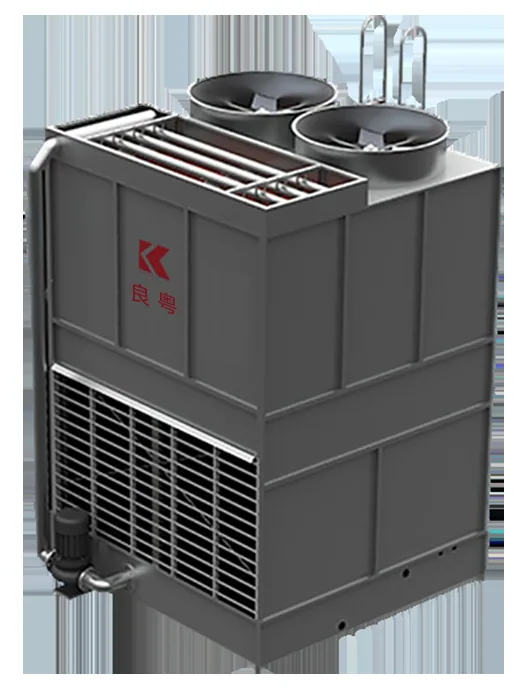
Where blowdown comes from
In a closed circuit tower, the process fluid stays inside the coil, but the separate spray-water loop still evaporates. As pure water evaporates, dissolved calcium and magnesium salts concentrate until calcium carbonate exceeds its solubility limit and begins to precipitate on the coil surface.
Suspended solids, airborne dust and biological growth add to the load. Blowdown — deliberately discharging a portion of the concentrated spray water and replacing it with fresh make-up — keeps dissolved solids below the threshold.
Controlling the rate
Base blowdown on conductivity or cycles of concentration rather than a fixed timer. Conductivity-controlled automatic blowdown responds to real evaporation and avoids both over-discharge and scale build-up. Keep the spray water distribution uniform: dry spots on the coil scale much faster than wetted areas.
Water temperature, pH and make-up water hardness all shift scaling tendency, so seasonal reviews are worthwhile. A side-stream filter helps with suspended solids, while an approved biocide programme controls biological growth.
Practical checklist
Monitor conductivity, pH and spray pressure; inspect the coil and drift eliminator quarterly; verify nozzle wetting patterns; and log make-up and blowdown volumes. These records make performance losses visible long before capacity is affected.
Need this applied to your project?
Send your heat load, flow rate and design wet-bulb temperature for a technical proposal.
Request a QuoteTalk to a cooling tower engineer
Technical selection, drawings and a quotation — usually within one business day.